
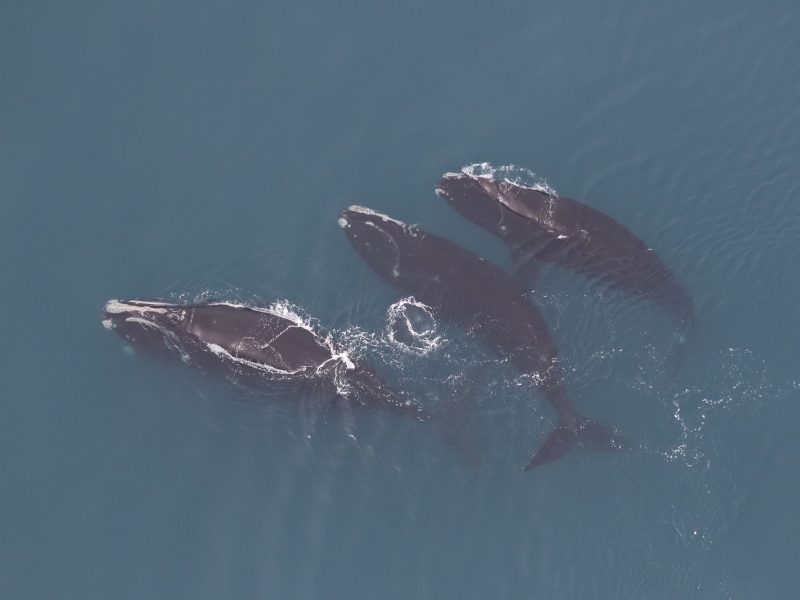
2024-2025 Large Whale Season Summary
March 24, 2025
We have two separate efforts focusing on cetaceans off the coast of Virginia. The first is our Offshore (Outer Continental Shelf) Cetacean Study, which focuses primarily on deep diving odontocetes like sperm whales. The second effort is our Nearshore and Mid-Shelf Baleen Whale Monitoring Project.
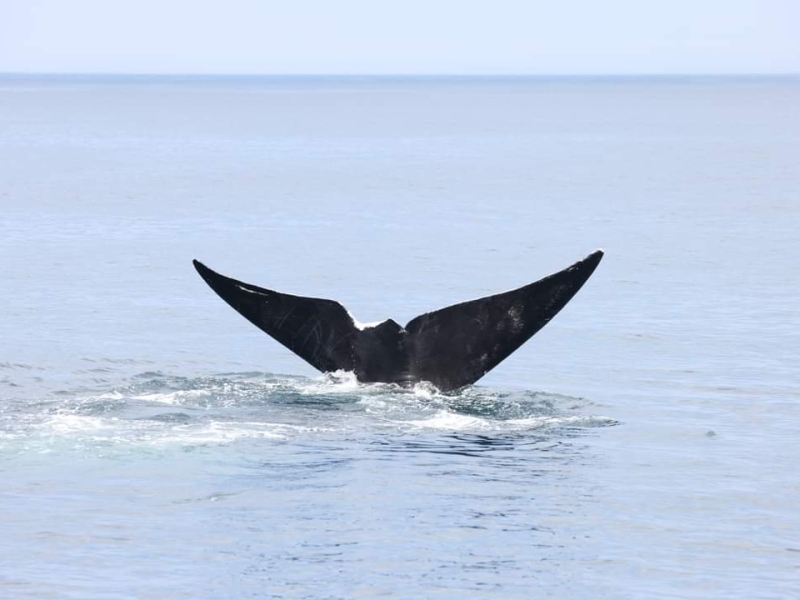
Whales of Summer
June 10, 2024
In the mid-Atlantic, baleen whale sightings typically occur during the colder months, with peak activity in December and January. Sightings of humpback and right whales usually decrease by late March through April. While occasional baleen whale sightings, particularly of fin whales, happen during warmer months, large groups are uncommon as summer approaches. Pelagic surveys during this time often focus on odontocetes like sperm whales and beaked whales.
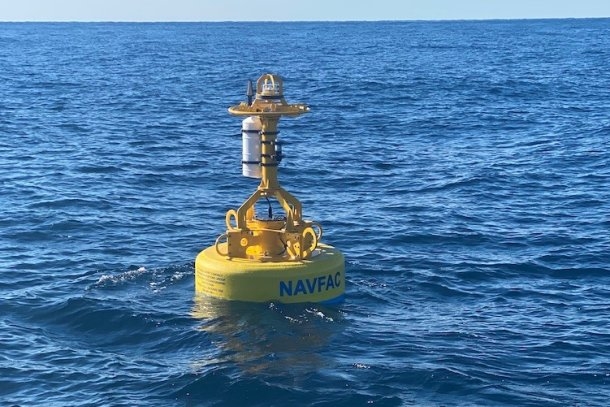
New acoustic monitoring buoy helps researchers study and protect North Atlantic Right Whales
January 19, 2021
A new buoy to listen for protected whales.
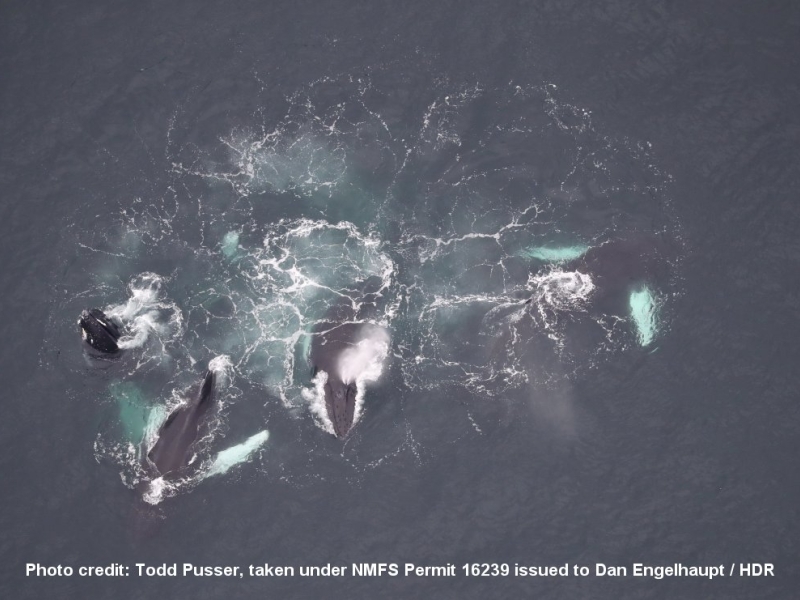
Blue whales and sei whales and right whales - OH MY!!!
April 18, 2018
A spring aggregation of endangered whales offshore.
Current
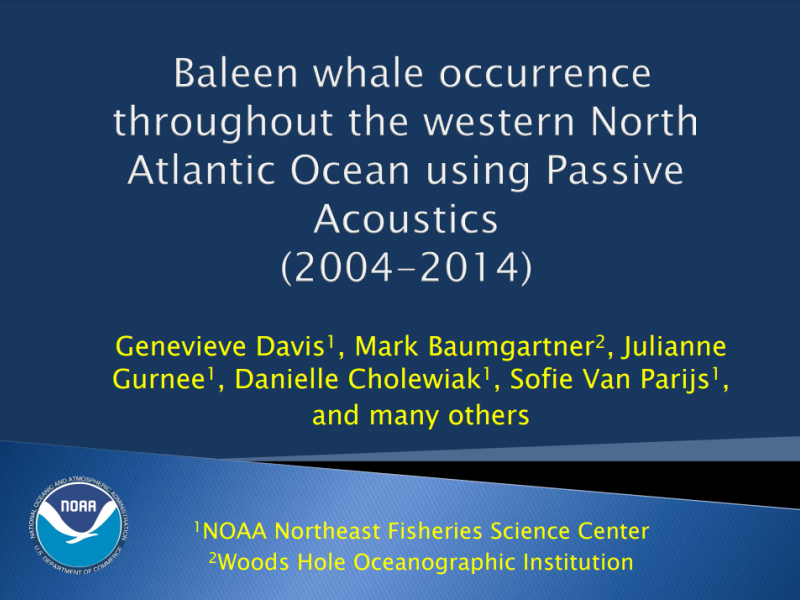
Passive Acoustic Monitoring for Mid-Atlantic Baleen Whales
Project Objectives
Monitor large whale occurrence in the Mid-Atlantic
Complete
Mariana Islands Sea Turtle and Cetacean Survey (MISTICS)
Project Objectives
Determine what species of marine mammals and sea turtles are present and estimate abundance.
Complete
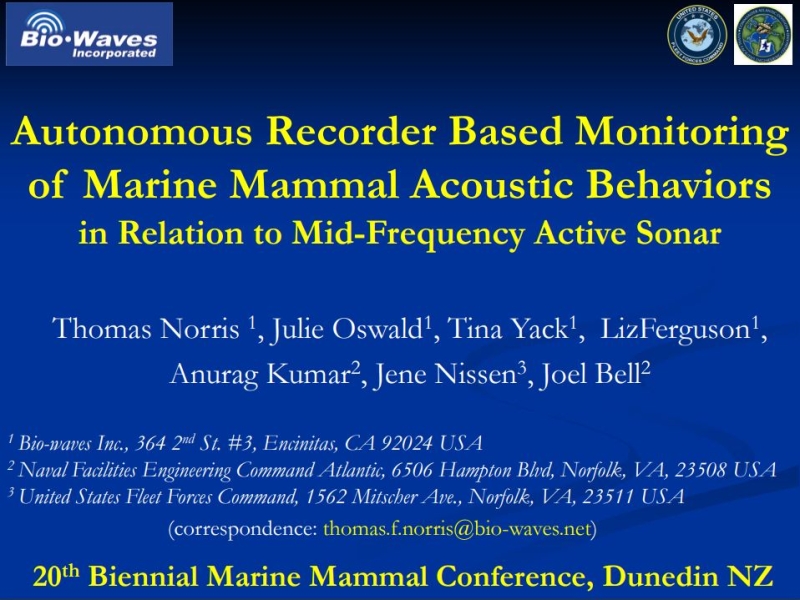
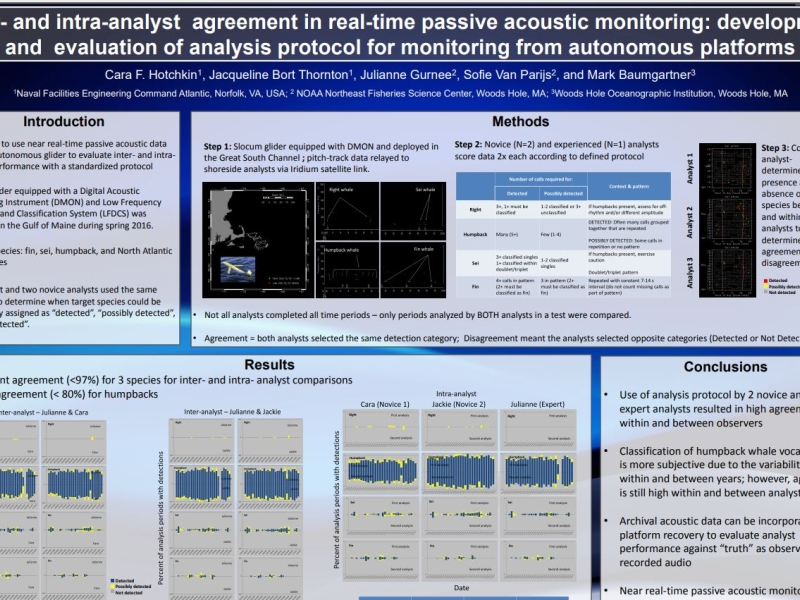
Autonomous Real-Time Passive Acoustic Monitoring of Baleen Whales for Mitigating Interactions with Naval Activities
Project Objectives
Demonstrate near real-time passive acoustic detection and classification hardware/software systems
Current
Long Term Acoustic Monitoring of Marine Mammals Utilizing the Instrumented Range at Pacific Missile Range Facility (PMRF)
Project Objectives
Improve understanding of the long term trends in occurrence of marine mammals (e.g., minke, humpback, fin, Bryde's, Blainville's) on the PMRF range. Examine what, if any, acoustic and physical behavioral responses occur to Navy activities.
Current
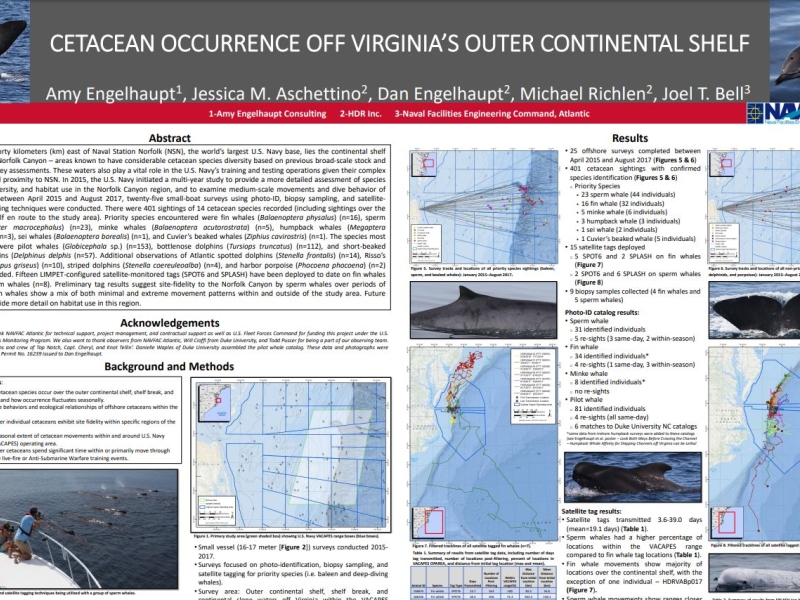
Mid-Atlantic Offshore Cetacean Study
Project Objectives
Assess occurrence, habitat use, and baseline behavior of cetaceans in the offshore and continental shelf break region of the VACAPES OPAREA
Current
Mid-Atlantic Nearshore & Mid-shelf Baleen Whale Monitoring
Project Objectives
Assess occurrence, habitat use, and baseline behavior of baleen whales in the mid-Atlantic region
Effects of Pile Driving on Marine Mammal Behavior in Puget Sound, Washington, USA.
ESOMM - 2014 5th International Meeting on the Effects of Sound in the Ocean on Marine Mammals .
More details
Collapse details
Date Published:
Filesize:
- September 7, 2014
Marine mammal (MM) monitoring was conducted during in-water pile driving (PD) at Hood Canal, Washington, during fall 2011. Monitoring was performed on construction days, during active-construction (“AC”, defined as 30 minutes prior to, during, and 30 minutes after PD) and non-construction (“NC”, downtime) periods. Baseline surveys were also conducted throughout Hood Canal on days when no PD occurred. Monitoring and baseline surveys occurred over 53 days. Marine Mammal Observers (MMOs) recorded 1,207 sightings totaling 2,269 individual MM.
- 1,481.12 KB
More details
Collapse details
Date Published:
Filesize:
- March 1, 2020
Status report for the acoustic and visual survey for cetaceans in Behm Canal and Southern Clarence Strait, Alaska, FY22.
- 1,227.95 KB
More details
Collapse details
Date Published:
Filesize:
- May 12, 2025
The National Oceanic and Atmospheric Administration (NOAA) Alaska Fisheries Science Center has maintained passive acoustic recorder moorings in areas of interest to the US Navy in the Gulf of Alaska (GOA). Archival data from three of these sites were analyzed for the timing and occurrence of key cetacean species. In addition, three subsurface passive acoustic moorings were deployed for a year (fall 2023 to fall 2024) in areas of mutual interest to NOAA and the Navy. Two of these new moorings, located along the western GOA slope, were redeployed in 2024.
- 2,832.58 KB
More details
Collapse details
Date Published:
Filesize:
- February 28, 2022
The Pacific Marine Assessment Program for Protected Species (PacMAPPS) survey occurred from 1 August to 26 August 2021, beginning and ending in Kodiak, AK. Over the course of the survey, a total of 2,330 km of on-effort tracklines were surveyed in suitable weather conditions, and a total of 687 sightings of marine mammals were documented (including duplicates and resights).
- 2,637.82 KB
More details
Collapse details
Date Published:
Filesize:
- December 18, 2023
This survey implemented visual line transect and passive acoustic methods to assess the presence and distribution and to estimate density and abundance of cetaceans in Behm Canal and central Clarence Strait.
- 1,093.33 KB
More details
Collapse details
Date Published:
Filesize:
- August 7, 2017
Taking into consideration the multiple intermediate scientific objectives in the U.S. Navy’s Strategic Planning Process (DoN 2013b), the goals of this study are to assist the U.S. Navy and regulatory agencies with environmental planning and compliance by addressing the following questions: • Which cetacean species occur over the outer continental shelf to the east of NSN, and how does occurrence fluctuate seasonally? • What are the baseline behaviors and ecological relationships of offshore cetaceans within the study area? • Do individual cetaceans exhibit site fidelity within specific regions of the study area over periods of weeks, months, or years? • What is the seasonal extent of cetacean movements within and around U.S. Navy VACAPES training range boxes? • Do cetaceans spend significant time within or primarily move through areas of U.S. Navy live-fire or Anti-Submarine Warfare training events?
- 4,742.41 KB
More details
Collapse details
Date Published:
Filesize:
- May 1, 2018
Taking into consideration the multiple intermediate scientific objectives in the U.S. Navy’s Strategic Planning Process (DoN 2013b), the goals of this study are to assist the U.S. Navy and regulatory agencies with environmental planning and compliance by addressing the following questions: Which cetacean species occur over the outer continental shelf to the east of NSN, and how does occurrence fluctuate seasonally? What are the baseline behaviors and ecological relationships of offshore cetaceans within the study area? Do individual cetaceans exhibit site fidelity within specific regions of the study area over periods of weeks, months, or years? What is the seasonal extent of cetacean movements within and around U.S. Navy VACAPES training range boxes? Do cetaceans spend significant time within or primarily
- 6,780.82 KB
More details
Collapse details
Date Published:
Filesize:
- October 1, 2016
A combination of visual line-transect survey, photo-identification (photo-ID), and automated acoustic monitoring methods was used to gather important baseline information on the occurrence, distribution, and density of marine mammals near Naval Station Norfolk (NSN) and adjacent areas. The study area was designed to cover areas where United States Navy activity is substantial, including Chesapeake Bay waters near NSN and Joint Expeditionary Base Little Creek-Fort Story, as well as a Mine Exercise (MINEX) Area (W-50) in the Atlantic Ocean off the coast of Virginia Beach, Virginia
- 14,259.08 KB
Models Incorporating Non-Stationarity Improve Detection of Climate-Driven Range Shifts in Odontocetes.
Diversity and Distributions. 2026.
32 (2)
More details
Collapse details
Date Published:
- March 12, 2026
Harbor porpoise (Phocoena phocoena) recovery in the inland waters of Washington: Estimates of density and abundance from aerial surveys, 2013–2015.
Canadian Journal of Zoology. 2025.
505-515
More details
Collapse details
Date Published:
Publication:Ocean:Region:Species:Methods:
- October 10, 2025
The harbor porpoise (Phocoena phocoena (L., 1758)) used to be common in Puget Sound, Washington, but virtually disappeared from these waters by the 1970s. We conducted systematic aerial line-transect surveys (17 237 km total effort) for harbor porpoises, with the goal of estimating density and abundance in the inland waters of Washington State.
More details
Collapse details
Date Published:
Filesize:
- March 1, 2018
Ten bottom-mounted passive acoustic recorders have been deployed off the coast of Virginia beginning in July 2015 and was maintained for two years. A combination of high-frequency Autonomous Multichannel Acoustic Recorders (AMARs), and low-frequency Marine Autonomous Recording Units (MARUs) was deployed in two spatial configurations (Figure 1), with the AMARs in a linear array extending east from the mouth of the Chesapeake Bay across the continental shelf and MARUs deployed as a synchronized localization array within the WEA.
- 1,171.17 KB
More details
Collapse details
Date Published:
Filesize:
- March 22, 2022
The United States (US) Navy uses lookouts (LOs) to detect objects in the water in the vicinity of ships. One class of object that LOs are trained to detect is marine mammals ; this forms an important component of the Navy’s procedures for marine mammal mitigation during training activities . As well as dedications of marine mammals by these LOs, detections of marine mammals may also be made by other members of the ship’s crew such as officers on the bridge (“watchstanders”) or sonar technicians, although acoustic detections require visual confirmation. We refer to these personnel together as the “lookout team” (LT). The primary goal of this project was to determine how effective LTs are at detecting marin
- 4,078.84 KB
- California sea lion
- Green turtle
- Leatherback turtle
- Loggerhead turtle
- Kemp's Ridley turtle
- Blue whale
- Fin whale
- Humpback whale
- Minke whale
- Atlantic white-sided dolphin
- Common dolphin
- Harbor porpoise
- Killer whale
- Pantropical spotted dolphin
- Pilot whale
- Risso's dolphin
- Rough-toothed dolphin
- Short-finned pilot whale
- Sperm whale
- Spotted dolphin
- Striped dolphin
More details
Collapse details
Date Published:
Filesize:
- April 1, 2009
During this project, the visual survey covered a total of 760 kilometers (410 nautical miles) on-effort while transit and fog effort legs accounted for 553 km (298 nm). There were a total of 96 sightings (453 individuals) of 11 confirmed marine mammal species; these included fin, humpback, gray, and minke whales as well as killer whales, Dall’s and harbor porpoise, Pacific white-sided dolphins and Steller sea lions, harbor seals and sea otters. Additionally, there were 36 sightings (46 individuals) of unidentified large whales, dolphins and pinnipeds. Acoustically, operations were conducted 24-hours/day surveying a total of 3,519 km (1,900 nm) and recording 49 acoustic detections of sperm whales and killer whales. Photographs of nineteen individual killer whales and four fin whales were obtained on this cruise and compared to existing catalogs.
- 1,894.30 KB
More details
Collapse details
Date Published:
Filesize:
- April 1, 2014
During this survey, the visual team surveyed 4,504 kilometers (km) of ‘full-effort,’ which included 349 km of ‘transit-effort.’ There was an additional 375 km of ‘fog-effort’ (transect and transit). Based on total effort, there were 802 sightings (1,998 individuals) of 13 confirmed marine mammal species, with an additional 162 sightings (228 individuals) of unidentified cetaceans and pinnipeds (including those recorded on transit and during off-effort mode).
- 12,416.19 KB
Distribution, abundance, and density of harbor porpoises in Hood Canal, Washington.
Journal of Wildlife Management. 2024.
88(3):e22543
More details
Collapse details
Date Published:
Publication:Ocean:Region:Species:Methods:
- January 8, 2024
Harbor porpoises (Phocoena phocoena) are the only cetaceans routinely sighted in Hood Canal, a narrow fjord that comprises the western edge of Puget Sound, Washington, USA. Harbor porpoises are sensitive to anthropogenic sounds, including noise from recreational and commercial vessel traffic, and the United States Navy, which conducts military training and testing within Hood Canal that can include underwater sound sources. This study was funded as part of the Navy monitoring program to assess potential impacts of naval activities on cetaceans. We conducted vessel-based line-transect surveys for harbor porpoises in Hood Canal in 2022–2023 to derive seasonal estimates of abundance and density.
More details
Collapse details
Date Published:
Filesize:
- June 1, 2020
Here we present analyses of the DASBR deployments from the CCES 2018 project. We provide information on the times and locations of drift deployments and retrievals. Each drift is also illustrated on maps of the study area. We present analyses of cetacean echolocation detections 2 from DASBR recordings including those from beaked whales, sperm whales, and NBHF species. As in the previous 2016 study, beaked whale detections were dominated by Cuvier’s beaked whale. All the beaked whale species detected in 2016 were also detected in this 2018 study, plus the addition of a signal, designated BWC that had been previously detected in the central and western Pacific, but not previously in the eastern Pacific. Sperm whales and NBHF species were detected throughout the study area.
- 5,022.87 KB
More details
Collapse details
Date Published:
Filesize:
- June 1, 2017
From 2013 to 2016, we conducted systematic line-transect aerial surveys in 8 sub-regions of Puget Sound encompassing inland waters of Washington State. U.S.-funded surveys were conducted year-round and focused on estimating seasonal in-water density and abundance of marine mammals, particularly harbor porpoises and harbor seals
- 4,652.56 KB
More details
Collapse details
Date Published:
Filesize:
- December 31, 2015
From 2013 to 2015, researchers conducted systematic line-transect aerial surveys for marine mammals in eight subregions of Puget Sound encompassing inland waters of Washington State. Effort consisted of five separate survey periods spanning four seasons (winter, spring, summer and fall) and was funded by the United States Navy (Navy). Surveys focused on estimating seasonal in-water density and abundance of cetaceans, particularly harbor porpoise (Phocoena phocoena).
- 5,860.87 KB
Puget Sound marine mammal aerial surveys, 2013-2015.
Marine Mammal Working Group, Puget Sound Ecosystem Monitoring Program (PSEMP) .
More details
Collapse details
Date Published:
Filesize:
- January 15, 2015
Seasonal systematic aerial surveys of Puget Sound.
- 5,672.86 KB
Regional and seasonal density and abundance of harbor porpoise: Recolonization of Puget Sound, aerial surveys 2013-2015.
21st Biennial Conference on the Biology of Marine Mammals .
More details
Collapse details
Date Published:
Filesize:
- December 13, 2015
Although harbor porpoise (Phocoena phocoena) were historically common in Puget Sound in the 1940s, their abundance declined in successive decades, with no individuals observed in southern Puget Sound during 1994 aerial and vessel surveys. Since 2009, sightings, strandings and acoustic detections have increased, suggesting their recolonization of Puget Sound. We present the first regional and seasonal density estimates of harbor porpoise available for Puget Sound waters since the 1990s. We conducted systematic line-transect aerial surveys for marine mammals in eight sub-regions of Puget Sound in 2013-2015 during spring, summer and fall, funded by the U.S. Navy.
- 115.23 KB
More details
Collapse details
Date Published:
Filesize:
- April 21, 2023
In this study, we conducted line transect surveys to assess the seasonal distribution and abundance of marine mammals in Hood Canal (Washington), with emphasis on harbor porpoises (Phocoena phocoena) and killer whales (Orcinus orca).
- 13,626.84 KB